
Selecting among Pre Engineering Steel Building Manufacturers is an important procurement decision because the finished structure depends on engineering, material control, fabrication accuracy, documentation, and site coordination—not simply the supply of steel.
For procurement teams and project owners in Coimbatore, evaluating these capabilities before placing an order can reduce uncertainty during execution.
Start With Engineering Capability
Manufacturing should follow approved structural engineering.
Before awarding the project, understand how the supplier obtains design inputs and develops structural drawings.
The provider should ask about building dimensions, occupancy, loads, cranes, openings, mezzanines, roofing, and other relevant requirements.
If important inputs are missing, apparently competitive pricing may not represent the final building.
Review the Scope Line by Line
PEB quotations are not always directly comparable.
One manufacturer may include structural steel, roofing, accessories, transportation, and erection, while another proposal may exclude several of these items.
Create a scope comparison covering:
- Structural design
- Primary steel
- Secondary steel
- Roofing
- Wall cladding
- Fasteners and accessories
- Gutters and downpipes
- Flashings
- Transportation
- Erection
- Surface treatment
- Architectural elements
Clarifying exclusions is just as important as reviewing inclusions.
Understand Fabrication Controls
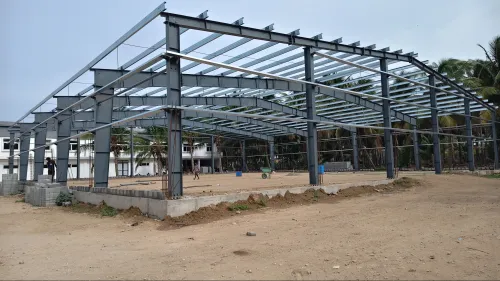
Factory fabrication should convert engineering drawings into components that can be assembled accurately at site.
Ask how the manufacturer manages material identification, cutting, drilling, welding, dimensional checks, surface preparation, marking, and dispatch.
Traceability and documentation become particularly valuable on larger projects involving many similar members.
Examine Connection Detailing
A steel building is not simply a collection of columns and rafters.
Connections transfer forces between members and are a critical part of the engineered structural system.
Bolts, plates, welds, connection geometry, and erection details should correspond to the structural design.
Substituting components casually at site can undermine the intended engineering.
Ask How Changes Are Managed
Project changes are common, but uncontrolled changes create risk.
A professional process should distinguish between preliminary drawings, approved drawings, fabrication drawings, and later revisions.
If a customer changes a shutter location or adds equipment, the effect should be reviewed before site modifications occur.
Evaluate Dispatch and Erection Planning
Manufacturing is only part of the project.
Components need to reach the site in an order that supports erection. Site access, unloading, storage, lifting equipment, and erection sequence should be considered.
For congested or active industrial sites, these logistics can materially affect execution.
Look Beyond the Lowest Initial Price
The lowest quotation is not automatically the lowest project cost.
Missing scope, late structural changes, inaccurate fabrication, delayed deliveries, or coordination problems can create costs elsewhere.
A better comparison considers engineering clarity, specified materials, fabrication quality, completeness of scope, erection support, and the supplier's ability to handle the required building type.
SAHARA STRUCTURES serves steel-building and PEB requirements from Coimbatore for industrial and structural applications in Tamil Nadu.
Before issuing a purchase order, procurement teams should make sure they understand exactly what has been designed, what will be manufactured, what will arrive at site, and who is responsible for erection and interfaces. That level of clarity provides a far more useful basis for selecting a manufacturer than comparing price per kilogram in isolation.
Keywords